 Switchmast
Twilio Messaging Services, explained
Updated
A Twilio Messaging Service groups your senders (numbers, short codes, sender IDs, RCS and WhatsApp senders) into a sender pool with shared settings. You send with its MessagingServiceSid and Twilio picks the sender. It adds Sticky Sender, Smart Encoding, the MMS Converter, Geomatch, scheduling and link shortening, and in the US it is where your A2P 10DLC campaign lives.
Why use one
Sending with From ties every message to one number you choose. Sending with a Messaging Service hands that choice to Twilio, which is what you want once you have more than one sender, need US 10DLC registration, or want features that only exist on services: scheduling, link shortening, RCS with fallback to SMS. Configuring services in the Console is generally available; configuring them through the REST API is a Public Beta. Sending through a service is generally available.
New to sending? Start with how to send and receive SMS with Twilio.
Sender pool
A service's sender pool can hold Alphanumeric Sender IDs, short codes, long codes, toll-free numbers, RCS senders and WhatsApp senders. When a message could go from several, Twilio picks by type in this order:
- RCS
- Short code
- Alphanumeric Sender ID
- Long code or toll-free (in Canada, toll-free comes before long code)
Within one type, traffic is spread evenly. Twilio warns not to put more than one toll-free number in the same service's pool. Twilio's docs give no maximum pool size.
Features, one by one
| Feature | Channels | What it does |
|---|---|---|
| Sticky Sender | SMS, WhatsApp | Each recipient keeps hearing from the same number |
| Smart Encoding | SMS | Swaps hidden Unicode look-alikes for GSM-7 characters |
| MMS Converter | SMS | Sends media as an SMS with a link when MMS isn't supported |
| Area Code Geomatch | SMS, US and Canada | Picks a number with the recipient's area code |
| Validity period | All | Drops messages still queued at Twilio after 1 to 36,000 seconds |
| Scheduling | SMS, WhatsApp | Sends at a set time, 15 minutes to 35 days ahead |
| Link shortening | SMS, WhatsApp | Shortens links on your own domain and tracks clicks |
| Advanced Opt-Out | SMS, RCS, WhatsApp | Custom opt-out, opt-in and help keywords and replies |
Sticky Sender
After the first message to a recipient, Twilio stores a mapping from that recipient to the sender it used and reuses it. People see one consistent number, and their replies come back to it. SMS and WhatsApp keep separate mappings. Turning the setting off ignores the mappings; turning it back on restores them. Removing a number deletes its mappings, and Twilio can drop a mapping and pick again, for example after an A2P registration check fails. Not available for RCS.
Smart Encoding
A single non-GSM character, such as a curly quote pasted from a word processor, switches the whole message to UCS-2 and cuts a segment from 160 characters to 70. Smart Encoding replaces those hidden Unicode characters with GSM equivalents so the message stays in GSM-7. It doesn't change emoji or languages such as Korean. Because you pay per segment, this setting can lower your bill directly; see Twilio SMS pricing.
MMS Converter
When the recipient's carrier doesn't support MMS, Twilio sends the media as an SMS with a short link (https://p.twil.io/ plus seven characters), which stays active for 365 days. The message is billed as SMS, and the link can add a segment. It doesn't let a number without MMS capability send media.
Area Code Geomatch
For US and Canadian recipients, Twilio picks a number in your pool whose area code matches or overlaps the recipient's. If there isn't one, it uses another US or Canadian number without regard to location. Useful when you hold local numbers in several regions.
Validity period
How long a message may wait in Twilio's queue before Twilio gives up: 1 to 36,000 seconds, default 36,000 (10 hours). Set it on the service or per message with ValidityPeriod. Short values suit one-time passcodes that are useless after a few minutes. It only applies inside Twilio; a carrier can still hold a message longer.
Scheduling
Send with MessagingServiceSid, ScheduleType=fixed and SendAt (ISO 8601), between 15 minutes and 35 days ahead. The message gets status scheduled; cancel it by updating it to Status=canceled. Each account and subaccount can hold up to 500,000 scheduled messages. Twilio says scheduling costs nothing; you pay only for messages sent. Without a Messaging Service, Twilio ignores the schedule and sends straight away.
Link shortening and click tracking
With a domain you own, set up through Twilio's onboarding, send with ShortenUrls=true and Twilio swaps each link for your domain plus ten characters, then posts a click event (or a preview event for link previews) to your callback. Links redirect for 90 days. It is part of Twilio's Engagement Suite. Your own branded domain is also safer for deliverability than public shorteners, which carriers treat as risky.
Inbound settings
When someone texts a number in the pool, the service decides where the message goes:
- Defer to sender's webhook (the default): each number's own "A message comes in" webhook is used.
- A webhook on the service: one request URL for every sender in the service, with an optional fallback URL if your TwiML fails.
- Autocreate a Conversation: hands the message to Twilio Conversations, which needs its own setup.
In the API these are use_inbound_webhook_on_number, inbound_request_url and fallback_url. With the service webhook chosen and no URL set, inbound messages aren't delivered to you. Set a Delivery Status Callback on the service too, and every message sent through it reports status there unless the message carries its own StatusCallback.
Messaging Services and A2P 10DLC
In Twilio, a US A2P 10DLC campaign is registered on a Messaging Service:
- A Messaging Service can be linked to only one campaign at a time. A campaign is one use case.
- The service needs at least one Twilio number in its pool. Add every number you'll use for that campaign before you submit it.
- When the campaign is approved, all the 10DLC numbers in that service are registered.
- The service reports
us_app_to_person_registeredin the API, and itsusecasecan be notifications, marketing, verification, discussion, poll or undeclared.
So if you send both one-time codes and marketing, plan two services and two campaigns. Sending marketing through a campaign registered for notifications is a common cause of error 30007 filtering. Toll-free numbers don't use 10DLC campaigns; they need toll-free verification.
Common mistakes
- Adding numbers after the campaign is submitted instead of before.
- Two toll-free numbers in one pool, against Twilio's warning.
- Expecting scheduling without a service: the message sends immediately.
- Inbound going nowhere: the service is set to its own webhook but no URL is filled in.
- Deleting a service: it can't be undone.
Edit services from your phone
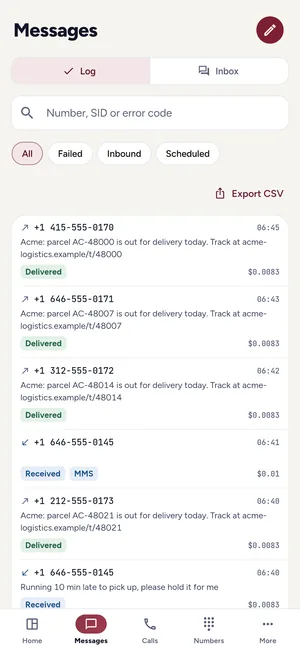
Switchmast lists your Messaging Services with their senders and lets you switch Sticky Sender, Smart Encoding, the MMS Converter and Area Code Geomatch, change the validity period and inbound webhook, and add or remove numbers. The message log shows which service sent each message, and delivery insights break down delivered and failed by sender, so a struggling service stands out.
Questions
What is a Twilio Messaging Service?
A container for one or more senders (numbers, short codes, sender IDs, RCS and WhatsApp senders) with shared settings. You send with its MessagingServiceSid and Twilio picks the sender and applies features such as Sticky Sender, Smart Encoding and scheduling.
Does a Messaging Service cost extra?
Twilio doesn't list a charge for the service itself; you pay for the messages. Message scheduling is free (Twilio charges only for messages sent). Link shortening is part of Twilio's Engagement Suite; check the SMS pricing page for its price.
Do I need a Messaging Service for A2P 10DLC?
Yes. In Twilio, a 10DLC campaign is registered on a Messaging Service, and its numbers are the 10DLC numbers in that service's sender pool. A Messaging Service can be linked to only one campaign at a time.
What is Sticky Sender?
A setting that keeps sending to each recipient from the same number. After the first message Twilio stores a recipient-to-sender mapping and reuses it. It works for SMS and WhatsApp, not RCS.
What is the default validity period?
36,000 seconds (10 hours). You can set 1 to 36,000 seconds on the service, or per message with ValidityPeriod. Messages still queued at Twilio past that time aren't sent; carriers may still queue messages beyond it.
Sources
- Twilio docs: Messaging Services (sender pool, features, inbound handling) (read 27 Nov 2026)
- Twilio docs: Service resource (properties, Public Beta, use cases) (read 27 Nov 2026)
- Twilio docs: Message scheduling (read 27 Nov 2026)
- Twilio docs: Link shortening (read 27 Nov 2026)
- Twilio docs: Direct standard and low-volume standard registration (one campaign per Messaging Service) (read 27 Nov 2026)
- Twilio docs: Message resource (StatusCallback override) (read 27 Nov 2026)