 Switchmast
A2P 10DLC registration on Twilio, step by step
Updated
A2P 10DLC is the US carriers' registration for business texts sent from ordinary 10-digit numbers. In Twilio you create a Customer Profile, register a brand (who you are), register a campaign (what you send and how people opt in), then add your numbers to the campaign's Messaging Service. Twilio estimates campaign approval at under one week.
What A2P 10DLC is, and who must register
10DLC means 10-digit long code: a normal US phone number, like the ones you text friends from. A2P means application-to-person: messages sent by software rather than typed by a person. The carriers built the 10DLC system because long-code routes meant for person-to-person texting were being used for spam.
Twilio's rule is broad: anyone sending SMS or MMS over a 10DLC number from an application to US recipients must register, including individuals and hobbyists. Registered traffic gets less filtering and more throughput. Unregistered traffic from a Twilio 10DLC number to the US is blocked with error 30034.
Not covered by 10DLC: toll-free numbers (they need toll-free verification), short codes (their own carrier application) and Twilio Verify, which sends one-time passcodes without you registering a campaign.
Pick a brand type
| Sole proprietor | Low-volume standard | Standard | |
|---|---|---|---|
| Who it's for | Individuals and businesses without a US tax ID (EIN) | Businesses with a tax ID sending fewer than 6,000 segments a day | Businesses with a tax ID that need more throughput |
| Campaigns per brand | One | Up to five (more with a valid reason) | Up to five (more with a valid reason) |
| Daily limit to T-Mobile | 1,000 segments (about 3,000 across US carriers) | Up to 2,000 (about 6,000 across carriers); 200,000 for Russell 3000 companies | From 2,000 to unlimited, set by your Trust Score |
| Numbers per campaign | One | Several, in the Messaging Service's sender pool | |
A segment is one 160-character piece of a text (see SMS pricing). The Trust Score is a rating your brand gets from vetting; higher scores unlock higher daily limits. Each tax ID can register up to five Standard or Low-Volume Standard brands; campaigns on extra brands may be rejected in vetting without a clear business reason.
Registration steps in the Twilio Console
- Create a Primary Customer Profile in Trust Hub (business name, address, authorized contacts) from the A2P Onboarding page, tab Create Customer Profile. It's a one-time step shared with other Twilio compliance products. Twilio says approval may take 72 hours or more; you can carry on meanwhile.
- Register the brand on the Register Brand tab (in the new Console: Communications › Trust Hub › Registrations › A2P Brands › Create A2P Brand). Twilio submits it to The Campaign Registry (TCR). Public for-profit companies also give a brand contact email for a 2FA identity check. Review usually takes a few minutes; if it goes to manual review (status IN_REVIEW), expect seven business days or more.
- Set up a Messaging Service with at least one 10DLC number in its sender pool. One Messaging Service links to one campaign at a time. Add all numbers before you submit.
- Register the campaign on the Campaign Registration tab. Pick the use case (marketing, account notifications, two-factor and so on), describe what you send, give sample messages, explain how people opt in, link your privacy policy and terms, and set your opt-out and help replies. Some use cases need extra carrier review.
- Wait for approval. Standard use cases take up to 5 business days. Twilio asks you to contact support if a campaign is still in progress after 10 days.
- Wait for the numbers. After approval each number in the Messaging Service is registered with the carriers, separately. It can send once its status is
REGISTERED; until then texts fail with 30035.
Brand statuses: APPROVED (you can see your limits), IN_REVIEW (manual review), FAILED (see the reasons on the Brand Overview page), SUSPENDED (may break registration rules).
Fees
Brand fees from Twilio's A2P 10DLC Brand Registration docs; campaign fees from Twilio's US 10DLC page. Both read 27 November 2026, in USD. These are on top of normal per-message prices and carrier fees.
| Brand type | Brand registration (one-time) | Campaign vetting (one-time, per campaign) | Campaign fee (monthly, per campaign) |
|---|---|---|---|
| Standard | $4.50 + $41.50 vetting = $46 | $15 | $1.50–$10 |
| Low-volume standard | $4.50 | $15 | $1.50–$10 |
| Sole proprietor | $4.50 | $15 | $2 |
Extra brand fees on the same docs page: a $11 appeal per request (Standard brand vetting rejections only), Authentication Plus at $12.50 per request (public for-profit brands), and political vetting at $66 to $96 a year.
Twilio's US 10DLC marketing page still lists the older brand fees ($44 standard, $4 low-volume and sole proprietor); the brand docs above give the current split. The monthly fee depends on the campaign's use case; the Low-Volume Mixed use case (fewer than 2,000 segments a day to T-Mobile) has a lower monthly fee. The $15 vetting fee is charged once per campaign, so editing and resubmitting a rejected campaign is cheaper than deleting it and starting again.
A worked first-year cost
A small business with an EIN registers a Low-Volume Standard brand and one campaign whose use case carries the top $10 monthly fee: $4.50 + $15 once, then $10 a month, or $139.50 in the first year before any messages or the number ($1.15 a month for a US local number). The same campaign on a Standard brand adds the $41.50 vetting, $181 in the first year. Check your use case's actual monthly fee in the Console before you budget.
Throughput
Besides the daily T-Mobile limits above, Twilio's 10DLC page says registered campaigns can reach up to 225 messages per second each. Your actual limit depends on brand type and Trust Score; Twilio shows it once the brand is approved. Sending faster than your campaign allows returns 30022; going over the brand's daily cap returns 30023.
What to prepare before you start
- Legal business name, EIN (for standard brands), address and a contact who can approve, with an email on your business domain.
- A working website with a privacy policy that says you don't share mobile numbers, plus public terms on the same domain that state message frequency and "message and data rates may apply". Since 30 June 2026 the privacy policy and terms URLs are required fields when you register a campaign through the API.
- A clear description of how people opt in (a web form, a checkbox, a keyword), with screenshots if the form isn't public. The opt-in box must not be pre-ticked.
- Two to five realistic sample messages that include your business name and opt-out wording ("Reply STOP to opt out").
- Your own short-link domain if messages contain links: public shorteners like bit.ly are a common rejection reason.
If the campaign comes back rejected, the rejection guide covers each code and its fix.
Track registration on your phone
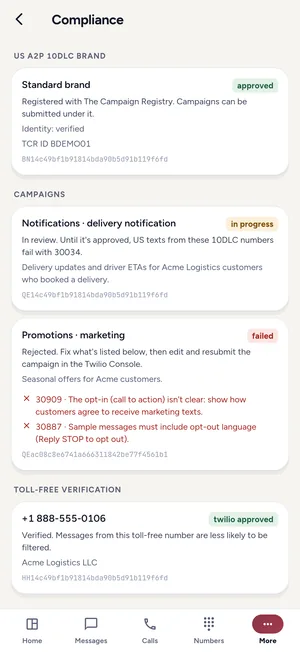
Switchmast shows your brand, each campaign and your toll-free verifications in one place, with each status and rejection reason as Twilio reports it, so you aren't refreshing Trust Hub for a week.
Questions
What does 10DLC stand for?
10-digit long code: an ordinary 10-digit US phone number. A2P (application-to-person) 10DLC is the US carriers' system for registering business texting sent from those numbers by software.
Do I need 10DLC registration to send SMS with Twilio?
Yes, if you send from a Twilio 10DLC number to US recipients from an application, even as a hobbyist. Twilio blocks unregistered US traffic from these numbers (error 30034). Toll-free numbers and short codes have their own processes, and one-time passcodes can go through Twilio Verify instead.
How much does 10DLC registration cost?
Twilio's brand registration docs (27 Nov 2026) list a one-time $4.50 TCR brand fee for every brand, plus $41.50 one-time vetting for a Standard brand, so $46 in all. Each campaign has a one-time $15 vetting fee and a monthly fee of $1.50 to $10 by use case ($2 for sole proprietor), per Twilio's US 10DLC page.
How long does 10DLC approval take?
Twilio estimates under one week for campaign approval. Its docs say a Customer Profile may take 72 hours or more, brand review usually takes minutes but seven business days or more when manually reviewed, and standard campaign review up to 5 business days.
What is The Campaign Registry (TCR)?
The Campaign Registry is the central registry the US carriers use for 10DLC brands and campaigns. Twilio submits your brand and campaign to it for you.
What if my campaign is rejected?
Edit and resubmit it rather than deleting it: the vetting fee is charged once per campaign and there is no limit on resubmissions. See 10DLC campaign rejected.
Sources
All read 27 November 2026.
- Twilio docs: A2P 10DLC Brand Registration (brand fees, appeal, Authentication Plus, political vetting, Console path)
- Twilio docs: What is A2P 10DLC? (who must register, brand types, daily limits, five brands per tax ID, Low-Volume Mixed)
- Twilio docs: Direct standard and low-volume standard registration (steps, statuses, review times)
- Twilio: 10DLC (monthly campaign fees, $15 vetting, approval estimate, 225 messages per second)
- Twilio docs: Gather the required business information (privacy policy and terms rules)
- Twilio docs: errors 30022, 30023, 30034, 30035, 30933