 Switchmast
What is CPaaS? Communications platform as a service, explained
Updated
CPaaS (communications platform as a service) is a cloud platform that lets developers add texting, calling, video, email and verification codes to their own apps through APIs, without building telecoms infrastructure. It's usually billed per message, per minute or per request. Twilio is one of the best-known CPaaS providers.
CPaaS meaning, in plain English
Sending a text message from software used to mean signing deals with mobile carriers, connecting to their networks and handling their rules. A CPaaS provider does that once, for everyone, and exposes it as an API. Your code makes an HTTPS request ("send this text to this number"), and the provider routes it through its carrier connections.
Twilio's definition: "a cloud-based platform that embeds real-time communications channels", delivered through APIs and SDKs. Infobip's: "a cloud-based platform that allows organizations to add communication services to their applications". The idea is the same: communications as a building block inside your product, not a separate phone system.
How CPaaS works
- You get credentials and numbers. An account, API keys, and phone numbers or sender IDs to send from.
- Your app calls the API to send a message, place a call or start a verification.
- The provider connects to the networks: mobile carriers for SMS, the public phone network for calls, Meta for WhatsApp, email servers for email.
- Events come back as webhooks. When someone replies, calls your number or a message is delivered or fails, the provider sends an HTTP request to your server, and your server answers with what to do next.
- You pay for what you use, usually monthly in arrears or from prepaid credit.
Providers also take on what Twilio's guide calls "ongoing carrier relationships, and constant maintenance as regulations and channels evolve": in the US, for example, business texting from ordinary numbers needs A2P 10DLC registration, which the provider submits for you.
Typical channels and uses
| Channel | Common uses |
|---|---|
| SMS and MMS | Delivery updates, appointment reminders, alerts, two-way support texting |
| Voice | Phone menus (IVR), call forwarding, call tracking, number masking, outbound reminder calls |
| Messaging apps (WhatsApp and others) | Customer support, order updates, marketing where users opted in |
| Verification | One-time passcodes for sign-up, login and password resets |
| Video and in-app calling | Telehealth, tutoring, support calls inside an app |
| Receipts, password resets, newsletters |
Twilio's guide gives the familiar examples: "a ride-share app that texts you when your driver arrives, a healthcare app that sends appointment reminders".
CPaaS vs UCaaS vs CCaaS
Three similar acronyms, three different buyers.
| CPaaS | UCaaS | CCaaS | |
|---|---|---|---|
| Stands for | Communications platform as a service | Unified communications as a service | Contact center as a service |
| What it is | APIs and SDKs | A ready-made business phone, meetings and chat system | Ready-made, configurable contact center software |
| Who uses it | Developers, inside your product | Your employees, talking to each other and to callers | Your support and sales agents |
| Typical features | Send SMS, make calls, verify numbers, webhooks | Desk phone numbers, video calls, team messaging | Agent inbox, routing, IVR, analytics |
| Typical pricing | Per message, minute or request | Per user per month | Per agent (per user or per hour) |
| Effort | You build it | Sign up and set up | Set up and configure; often customise |
The lines blur. Twilio's guide puts it as "CPaaS is for embedding communications into your own products", while UCaaS is for internal collaboration. Some contact center products are built on a CPaaS, and some CPaaS providers sell a contact center too.
How CPaaS is priced
Twilio's guide sums it up: "CPaaS is typically billed by usage: per message sent, per call minute, per API call." In practice a bill usually has:
- Per-use charges: per SMS segment, per call minute, per verification, per lookup.
- Monthly number fees for each phone number you keep.
- Pass-through fees from carriers and registries, such as per-message carrier fees and US 10DLC registration fees.
- Volume discounts or committed-use contracts for large senders.
That makes it cheap to start and easy to scale, but harder to predict than a flat subscription. For how this works on Twilio specifically, see Twilio pricing, and for texting costs, Twilio SMS pricing.
Where Twilio fits
Twilio's docs describe it as a "cloud communications platform", which they also call "communications platform as a service, or CPaaS", and say the term emerged when companies like Twilio started offering communications APIs to developers. Its products map onto the layers above:
- CPaaS building blocks: Programmable Messaging (SMS, MMS, WhatsApp), Programmable Voice, phone numbers, Verify, Lookup, Conversations, Video and Elastic SIP Trunking.
- Tools on top: Studio (a visual flow builder), Functions (serverless code) and TaskRouter (routing).
- Contact center: Twilio Flex, a CCaaS built on those same APIs.
Other providers that describe themselves as CPaaS include Vonage, Infobip and Sinch, which Twilio's own guide names alongside it. Each publishes its own prices and coverage; compare on the countries and channels you need, the per-unit prices there, and how much of the compliance work the provider does for you.
Is CPaaS right for you?
A CPaaS fits when communications are part of your product (your app sends the texts, places the calls or verifies the users) and you have developers to build on APIs. If you just need office phone lines, a UCaaS product is simpler. If you need a customer service team on several channels without building much, look at CCaaS, including those built on a CPaaS.
Running a CPaaS account day to day
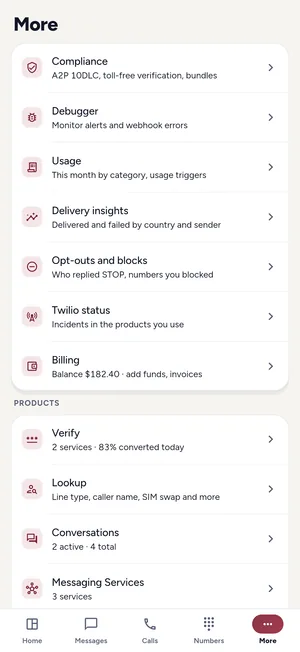
The catch with any CPaaS is that the dashboard lives in a browser and problems arrive by webhook at odd hours. Switchmast is an independent iPhone console for one CPaaS, Twilio: message and call logs with error codes explained, an inbox for texts to your numbers, live calls, numbers, usage and spend, 10DLC status and the Debugger, plus Studio, Verify, Lookup and more under one menu.
Questions
What does CPaaS stand for?
Communications Platform as a Service: a cloud platform that lets developers add messaging, voice, video, email and verification to their own software through APIs, without running telecoms infrastructure.
Is Twilio a CPaaS?
Yes. Twilio's own docs describe it as a cloud communications platform, also called communications platform as a service or CPaaS. Its APIs cover SMS, voice, WhatsApp, verification, phone number lookup and more.
What is the difference between CPaaS and UCaaS?
CPaaS is building blocks for developers to put communications into their own products. UCaaS (unified communications) is a finished product for a company's own staff: business phone lines, video meetings and team chat.
What is the difference between CPaaS and CCaaS?
CCaaS (contact center as a service) is cloud software for running a customer service team: agent inbox, routing, IVR and reporting. CPaaS is the lower layer of APIs; some CCaaS products, such as Twilio Flex, are built on a CPaaS.
How is CPaaS priced?
Usually by usage: per message, per call minute or per API request, plus monthly fees for phone numbers. Carriers' own fees and registration costs (such as US 10DLC) are often passed through on top.
Sources
- Twilio: CPaaS explained (definition, CPaaS vs UCaaS, pricing model, examples, providers named) (read 27 Nov 2026)
- Twilio docs: What is a platform? (Twilio as a CPaaS) (read 27 Nov 2026)
- Infobip: What is CPaaS? (definition, channels, use cases) (read 27 Nov 2026)
- Infobip: What is CCaaS? (definition, typical features) (read 27 Nov 2026)
- Twilio docs: Flex (read 27 Nov 2026)