 Switchmast
SMS pumping fraud: spot it and stop it on Twilio
Updated
SMS pumping is fraud where bots submit phone numbers to your sign-up or OTP form so you text number ranges controlled by an operator that shares the revenue with them. On Twilio, defend with Verify Fraud Guard or SMS Pumping Protection, switch off unused countries in Geo Permissions, rate-limit, add bot checks and watch OTP conversion.
How the scheme works
Twilio describes it like this:
- A fraudster finds a form on your site or app that sends a text when someone enters a phone number: a sign-up code, a login code, an "send me the app link" box.
- Bots submit thousands of numbers from a range controlled by one mobile network operator.
- You pay to send each message. The operator earns termination revenue for every one and passes a share to the fraudster.
Sometimes the operator is in on it. Sometimes it isn't: a smaller operator is paid by bigger ones for traffic, and a fraudster posing as a business promises it lots of volume. Either way, the goal is not to steal data but to generate paid traffic, which is why it falls under what Twilio calls artificially inflated traffic (AIT): usage generated only to increase traffic and cost. Twilio calls SMS pumping a common, but not the only, form of AIT. Voice has a cousin, international revenue share fraud (IRSF), where calls go to premium-rate numbers.
The cost lands on you. A US SMS segment is $0.0083 on Twilio (as of 27 Nov 2026), but Twilio's fraud guide says pumping typically aims at high-cost or premium country prefixes. For comparison, a UK SMS to a mobile is $0.056 per segment on Twilio's UK pricing page (as of 27 Nov 2026). See Twilio SMS pricing.
Warning signs
- A spike to blocks of adjacent numbers on the same operator: +44 7700 900101, 900102, 900103…
- Codes sent but never entered. Your OTP conversion rate (codes verified ÷ codes sent) falls, especially for one country.
- Traffic to countries you don't serve, or have never sent to before.
- Requests from VPNs, Tor, proxies or cloud servers instead of home and mobile connections.
- Messaging spend jumping with no matching rise in sign-ups.
Twilio's protections
| Tool | Applies to | What it does | Where |
|---|---|---|---|
| Verify Fraud Guard | Verify, SMS channel | Blocks the destination prefix of suspected pumping; error 60410 | Verify > Services > your service > SMS |
| SMS Pumping Protection | Programmable Messaging SMS | Temporarily blocks suspicious messages; error 30450 | Messaging > Settings |
| Messaging Geo Permissions | Programmable Messaging SMS | Blocks whole destination countries; error 21408 | Messaging > Settings > Geo Permissions |
| Verify Geo Permissions | Verify | Blocks destination countries for verifications | Verify settings |
| Lookup SMS pumping risk | Any number | Returns a risk score before you send | Lookup API, sms_pumping_risk |
Verify Fraud Guard
If you send codes with Twilio Verify, Fraud Guard analyses your traffic and blocks the destination prefix when it detects pumping. It covers SMS only, not voice. Three levels:
- Basic: cautious blocking, recommended mainly for domestic North American traffic.
- Standard (the default): moderate blocking; false positives may rise slightly (under 1%).
- Max: aggressive blocking; occasional false positives (under 2%).
Blocked sends show as error 60410. Twilio says Fraud Guard comes at no extra charge. Unblock a real user from the Blocked Verifications tab in Verify logs, or add their number to the Safe List.
SMS Pumping Protection (Programmable Messaging)
If you send codes yourself through the Messages API, turn on SMS Pumping Protection at Messaging > Settings. It starts immediately. It is free for US and Canadian traffic; for other countries Twilio points to the Features section of each SMS pricing page. It may block messages to regions known for pumping, to countries your account has never texted, and traffic that looks automated. Blocked messages get error 30450, and the block is temporary, typically 15 to 30 minutes, longer if the activity continues. Each message carries RiskCheck, on by default; set it to disable only for traffic such as marketing sends, never for OTPs. Twilio itself recommends moving OTP sending to Verify.
Geo Permissions
The bluntest and most effective control. New accounts can text only the country of the number verified at sign-up; every other country is off until you enable it. Only Owners and Admins can change the list, and only in the Console, never through the API. Subaccounts inherit the parent's settings unless you turn inheritance off. A blocked country returns error 21408 at send time.
Step-by-step defence for a sign-up or OTP form
- Switch off every country you don't serve in Messaging Geo Permissions and, if you use it, Verify Geo Permissions. Do this first; it takes minutes.
- Turn on Fraud Guard (Verify) or SMS Pumping Protection (Messages API). Keep
RiskCheckon for codes. - Rate-limit per user, IP address and device, and per number range: no more than one message every few seconds to the same prefix. In Verify, add Service Rate Limits. Rate limits won't stop a determined attacker but slow them down.
- Add exponential delays between "resend code" requests.
- Stop bots before the text: a CAPTCHA or bot detection on the form, and friction such as confirming an email address before phone enrolment.
- Check the number first with Lookup: line type to text mobiles only, and the
sms_pumping_riskpackage (free for North American numbers, $0.025 elsewhere, as of 27 Nov 2026). - Block bad sources: requests from Tor, proxies and cloud providers.
- Turn off channels you don't use in Verify, such as voice, so attackers can't switch to calls.
- Monitor: track OTP conversion by country, and set Twilio usage triggers that call your webhook when messaging spend passes a threshold.
If you're under attack now
- Disable the targeted country in Geo Permissions. Sends to it stop immediately. Twilio's response guide says not to wait for Support before containing an attack.
- Turn on SMS Pumping Protection or raise Fraud Guard to Max.
- Put a CAPTCHA or a hard rate limit on the form, or take the form offline briefly.
- Collect Message SIDs, the time range and the destination country, and email Twilio at [email protected] with your Account SID, the product and a description.
Spot a spend spike on your phone
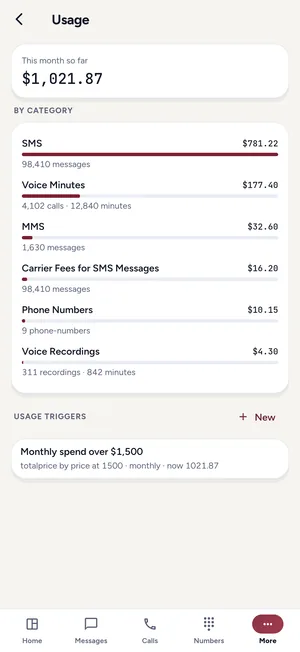
Pumping attacks often run at night or over a weekend. Switchmast shows this month's Twilio spend by category and today's message count on your iPhone, lets you create usage triggers from the Usage screen, and its delivery insights break messages down by destination country, so a sudden run of texts to a country you never serve stands out. Geo Permissions and Fraud Guard have no API, so you still switch those in Twilio's Console.
Questions
What is SMS pumping fraud?
Fraudsters use a phone number field on your site, such as sign-up or login, to trigger texts to number ranges run by a mobile operator they share revenue with. You pay for every message; they take a cut. Twilio counts it as a form of artificially inflated traffic (AIT).
How do I know if I'm being SMS pumped?
Twilio's signs: a spike of messages to blocks of adjacent numbers on one operator, often in a country you don't usually serve, and verification codes that are sent but never entered, so your OTP conversion rate drops.
Does Twilio protect against SMS pumping?
Yes, if you turn it on. Verify has Fraud Guard (Basic, Standard or Max). Programmable Messaging has SMS Pumping Protection under Messaging > Settings, free for the US and Canada. Geo Permissions block whole countries. Twilio says no provider-side tool gives 100% protection.
What is error 30450?
Message delivery blocked: SMS Pumping Protection judged the request suspicious and blocked that destination temporarily, typically for 15 to 30 minutes. Verify's equivalent, from Fraud Guard, is error 60410.
Will I be refunded for SMS pumping charges?
Twilio's docs don't promise refunds. They ask you to report messaging abuse to [email protected] with your Account SID, product, time range, destination country and a description.
Sources
- Twilio docs: What is SMS pumping fraud? (read 27 Nov 2026)
- Twilio docs: Fraud & Abuse Response Guide (AIT, high-cost prefixes, containment) (read 27 Nov 2026)
- Twilio docs: Preventing fraud (signs, rate limits, defences, reporting) (read 27 Nov 2026)
- Twilio docs: Verify SMS Fraud Guard (levels, error 60410, Safe List) (read 27 Nov 2026)
- Twilio docs: SMS Pumping Protection for Programmable Messaging (read 27 Nov 2026)
- Twilio docs: Error 30450 (read 27 Nov 2026)
- Twilio docs: SMS Geo Permissions (read 27 Nov 2026)
- Twilio: Lookup pricing (SMS pumping risk package) (read 27 Nov 2026)
- Twilio: US SMS pricing (read 27 Nov 2026)
- Twilio: UK SMS pricing (read 27 Nov 2026)